

Reconciliation requires kinship, cultural approach • APTN News
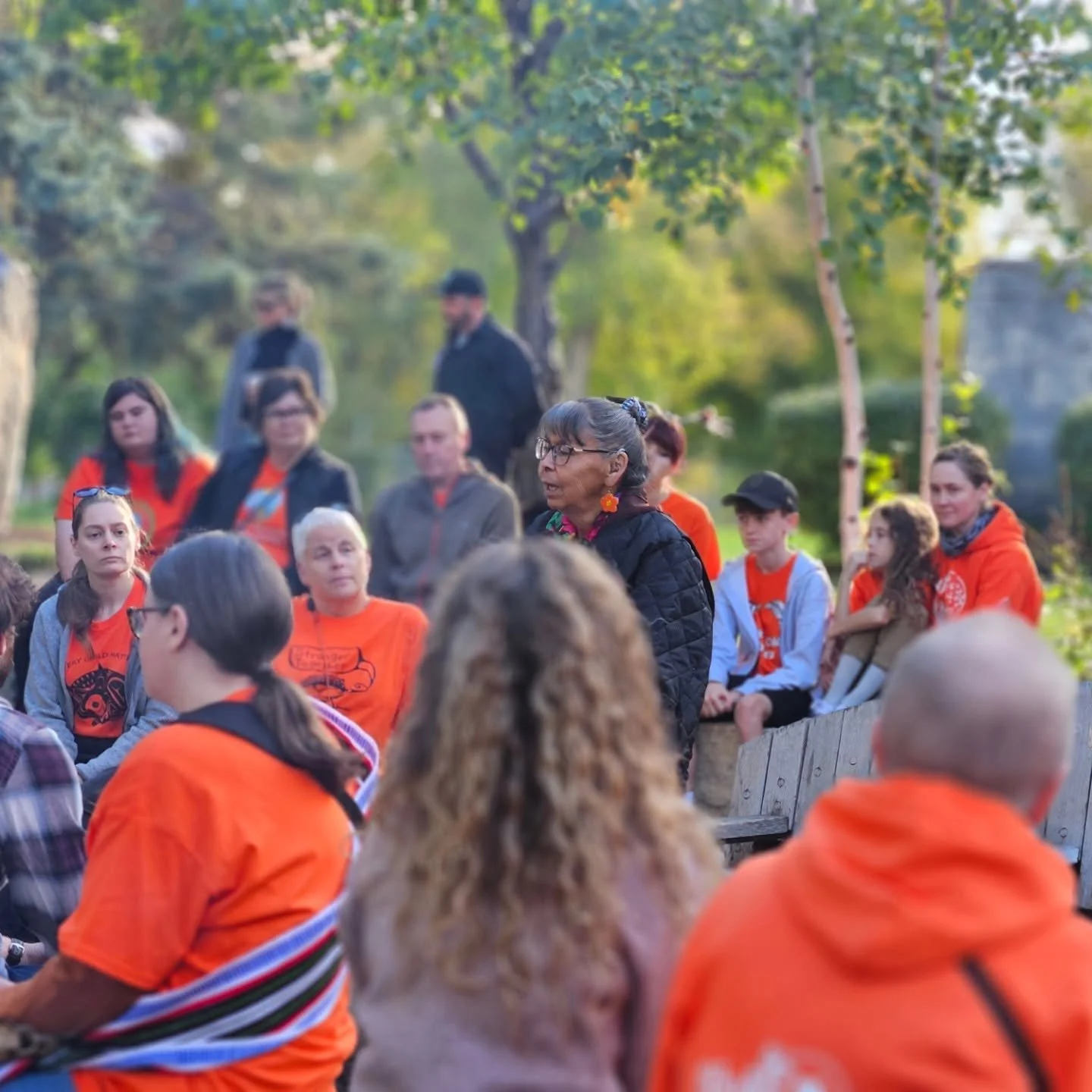
On this year’s National Day for Truth & Reconciliation, I was humbled to host an event alongside North End History, Winnipeg Indigenous Friendship Centre, Social Planning Council of Winnipeg, Zoongizi Ode & Kapabamayak Achaak (The Healing Forest Winnipeg) where community gathered to hear from Indian Residential School survivor Gramma Shingoose.
I posted some videos on social media about how important it is in the face of IRS denialism to protect survivors (watch on Facebook or watch on Instagram), as well as another video in collaboration with POP Entertainment & Management that highlighted 5 resources to help us on our journey of reconciliation.
Final Report of the Truth and Reconciliation Commission of Canada, Volume One: Summary
Indigenous Resistance and Development In Winnipeg 1960-2000 by Shaunna MacKinnon and Kathy Mallett
The Witness Blanket: Truth, Art and Reconciliation by Carey Newman and Kirstie Hudson (and you can go see the real life exhibit at the Canadian Museum for Human Rights)
The Secret Pocket by Peggy Janicki, illustrated by Carrielynn Victor
Phyllis's Orange Shirt by Phyllis Webstad illustrated by Brock Nicol
Finally, I spoke to some of our friends at APTN News about my approach to explaining reconciliation, orange shirt day and residential schools to students of different ages including the little ones.
Michael Redhead Champagne, a member of Shamattawa First Nation, is a public speaker and children’s author. He said he approaches the subject in two ways.
Firstly, he said, “the kinship approach.
“Just explain. People were taken from their families, and one way to make that better is to repair families,” he said. “Then, the education approach, where we say schools hurt Indigenous kids in the past. Let’s make sure school today help Indigenous Peoples.”
He can even then mesh the two into one sentence, he said — what can schools do today to support families who were hurt in the past?
“[The approaches] provide opportunities to learn and build relationships,” Redhead Champagne said, adding that through its simplicity, it works with adults, too.
For example, the Kapabamayak Achaak Healing Forest hosted an event on the morning of Sept. 30, when residential school survivor Gerry Shingoose, known by many as “Gramma Shingoose” in her community advocacy work, shared her story to a small crowd of varying ages around a sacred fire.
It was closed with the Travelling Song, performed by Knowledge Keeper Heather Bjorklund, accompanied by her daughter and granddaughter. Although, the youngest spent much of the song hiding in her mother’s jacket to avoid the crowd.
Redhead Champagne said it was an appropriate finish to the gathering, as it was an “act of intergenerational love.”